JUMP TO

TRANSLATE

WATCH THE VIDEO

OTHER VERSIONS OF THIS READING
INTRODUCTION
Imagine a country where people vote, but the person with the most votes does not become president. Imagine a president who lies under oath about an affair, gets impeached, but still leaves office very popular. Imagine bank leaders causing a major crisis, and then the government uses taxpayer money to rescue those banks. Imagine a president who tells thousands of lies.
These things have all happened in the United States in the past 30 years. George W. Bush and Donald Trump both lost the popular vote but became president by winning the electoral vote. Bill Clinton was impeached for lying about his affair but left office with a 66% approval rating. The TARP bailouts rescued big banks during the Great Recession. President Trump averaged more than 12 false statements per day during his first four years in office.
So what does this say about our political system? How can things like this happen?
What do you think? Is our political system broken?
GEORGE H. W. BUSH AND BILL CLINTON
President George H. W. Bush was a World War II veteran and the last president of his generation. Before becoming president, Bush had built a career in business and government. He served as head of the CIA and as vice president under Ronald Reagan.
Bush said he would continue Reagan’s economic approach, but he inherited major problems. Reagan’s policies of cutting taxes and increasing defense spending had caused the federal budget deficit to grow. By 1989, it was about three times larger than when Reagan took office in 1980.
Bush had also made a famous promise at the 1988 Republican Convention: “read my lips: no new taxes” But he faced pressure to reduce the deficit. Democrats in Congress wanted higher taxes on wealthy Americans. When Bush eventually agreed to raise taxes, many conservatives felt betrayed.
The differences between Bush and William “Bill” Clinton were huge. Clinton was a Baby Boomer born in 1946 in Hope, Arkansas. Compared with Bush, he was younger, seemed more relaxed and approachable. Clinton was known for strong people skills. He could make people feel heard and understood.
Clinton’s background was also very different. Bush was wealthy, but Clinton grew up with real struggles at home. Even so, Clinton excelled in school. He became interested in politics after meeting President John F. Kennedy.
As a student at Georgetown University, he supported civil rights and the antiwar movement. He later earned a Rhodes scholarship study at to Oxford University in England. He went on to Yale, where he earned a law degree in 1973.
Clinton was elected Arkansas’s youngest governor in 1978. He lost the job in 1980, then won it back in 1982 and stayed governor until 1992, when he ran for president.
During the campaign, Clinton called himself a New Democrat. This group of Democrats supported ideas like free trade and deregulation, which were also popular with Republicans. Clinton tried to appeal to the middle class. He promised higher taxes on the rich and changes to the welfare system.
Clinton won only 43% of the popular vote, but he won easily in the Electoral College, 370 to Bush’s 188. Bush’s support dropped because he broke his tax promise. Also, Texas billionaire H. Ross Perot won 19% of the popular vote, the strongest third-party showing since Theodore Roosevelt’s Bull Moose run in 1912.
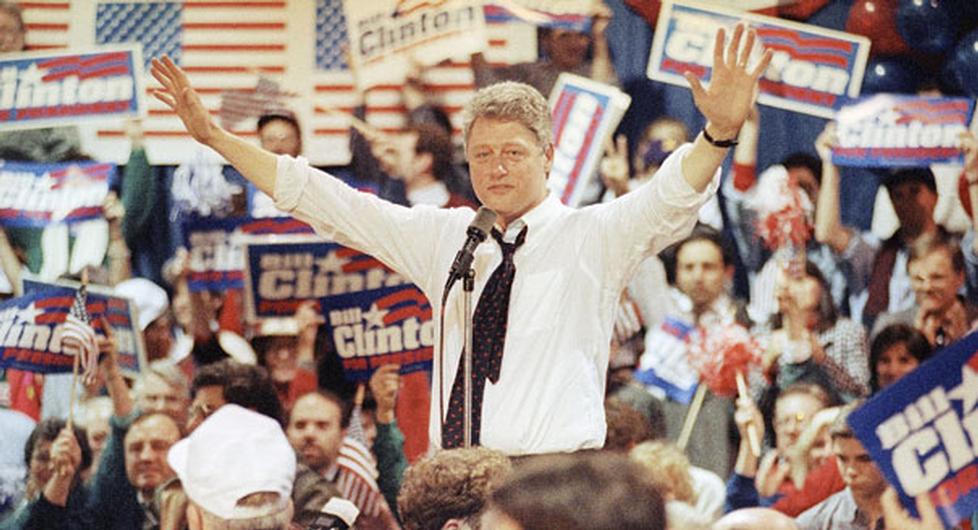 Primary Source: Photograph
Governor of Arkansas Bill Clinton campaigning for president as a New Democrat in 1992. He was the first Baby Boomer to be elected president.
CLINTON AND THE CONTRACT WITH AMERICA
As a New Democrat, Clinton raised taxes on wealthy Americans and lowered taxes for middle and lower income people. He also lowered tariffs to increase trade.
Clinton pushed the Senate to approve the North American Free Trade Agreement (NAFTA). Normally it was Republicans who wanted free trade and labor unions opposed these agreements, fearing free trade would lead to lost jobs for American workers. Labor unions tended to favor Democrats, but Clinton won them over by adding agreements to protect workers and the environment to NAFTA.
During the Clinton years, the economy grew for nearly ten straight years, the longest expansion in U.S. history. Jobs increased and the deficit shrank. Over time, increased tax revenue and spending cuts erased the federal budget deficit, and the government began running a surplus.
When the government borrows less, more money is available for private business. Interest rates can fall, which can encourage more growth. During the 1990s, home ownership reached record levels. Sales of the first personal computers and the birth of the internet also helped the economy grow. In 1994, the Clinton Administration launched the first official White House website.
Healthcare reform became a major part of Clinton’s agenda. Clinton appointed Hillary Clinton to lead his Task Force on National Health Care Reform in 1993. The Health Security Act aimed to provide universal coverage by raising taxes and using the money to pay medical bills for everyone.
At first, the plan looked promising. Some major groups supported it, including the American Medical Association and the Health Insurance Association of America. But politics changed quickly. As the 1994 midterm elections approached, Republicans saw an advantage in opposing the plan. Critics called it “Hillarycare” and argued it expanded federal power too much and would limit people’s ability to choose their own doctors.
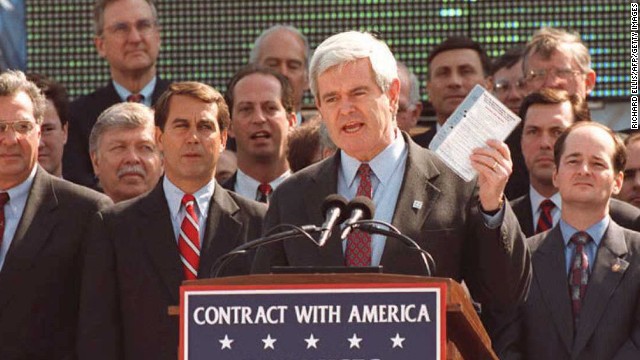 Primary Source: Photograph
Newt Gingrich holds a copy of the Contract with America during a press conference. His proposals helped propel Republicans to electoral victory in 1994.
To unite Republicans against Clinton, Newt Gingrich published a plan called the Contract with America. It listed eight reforms Republicans promised to pass if they won control of Congress in 1994. Many ideas focused on cutting spending and eliminating government waste. Many of the ideas in the Contract with America came from Ronald Reagan’s speeches.
Clinton’s healthcare bill failed in Congress. Opposition to the plan and support for the Contract with America helped Republicans win control of both the House and Senate in 1994. This Republican Revolution was one of the biggest shifts in power in decades. Gingrich became Speaker of the House and Clinton’s main opponent.
Republicans pushed conservative reforms. Clinton responded by working with them on some issues. One major law was the Personal Responsibility and Work Opportunity Reconciliation Act, better known as welfare reform. It set time limits on benefits and required many recipients to start working within two years.
Some historians see 1994 as a turning point. Gingrich was more combative than many older politicians. He often picked fights to show voters he was on their side, even when compromise might have solved problems. Over time, more politicians copied this style. Today, politicians who work with the other party can lose primaries to candidates from their own party who promise strict “purity” on issues and never to compromise.
THE IMPEACHMENT OF PRESIDENT CLINTON
Clinton’s opponents often tried to connect Bill and Hillary to crimes and unethical behavior. Some accusations were extreme or false. Others were serious.
One major issue involved a failed real estate deal in Arkansas tied to the Whitewater Development Corporation. Kenneth Starr, a former judge, was appointed to investigate.
Starr did not prove wrongdoing in the Whitewater deal, but his investigation kept growing and growing. Starr’s team heard a rumor that Monica Lewinsky, a young White House intern, had an affair with Clinton. Lewinsky and Clinton both denied under oath that they had a sexual relationship, but the evidence suggested otherwise. Starr investigated whether Clinton committed perjury by lying under oath.
Clinton denied the relationship in a famous TV speech and said, “I did not have sexual relations with that woman” Many people compared that statement to Nixon’s famous line, “I am not a crook.”
After Lewinsky received immunity, she provided evidence of the affair. Clinton admitted the affair but continued to argue that he had not lied under oath.
Republicans in the House voted to send articles of impeachment to the Senate, accusing Clinton of perjury and obstruction of justice. In February 1998, the Senate voted 45–55 on the perjury charge and 50–50 on obstruction of justice. Clinton was not removed, in part because a few Republican senators voted against impeachment.
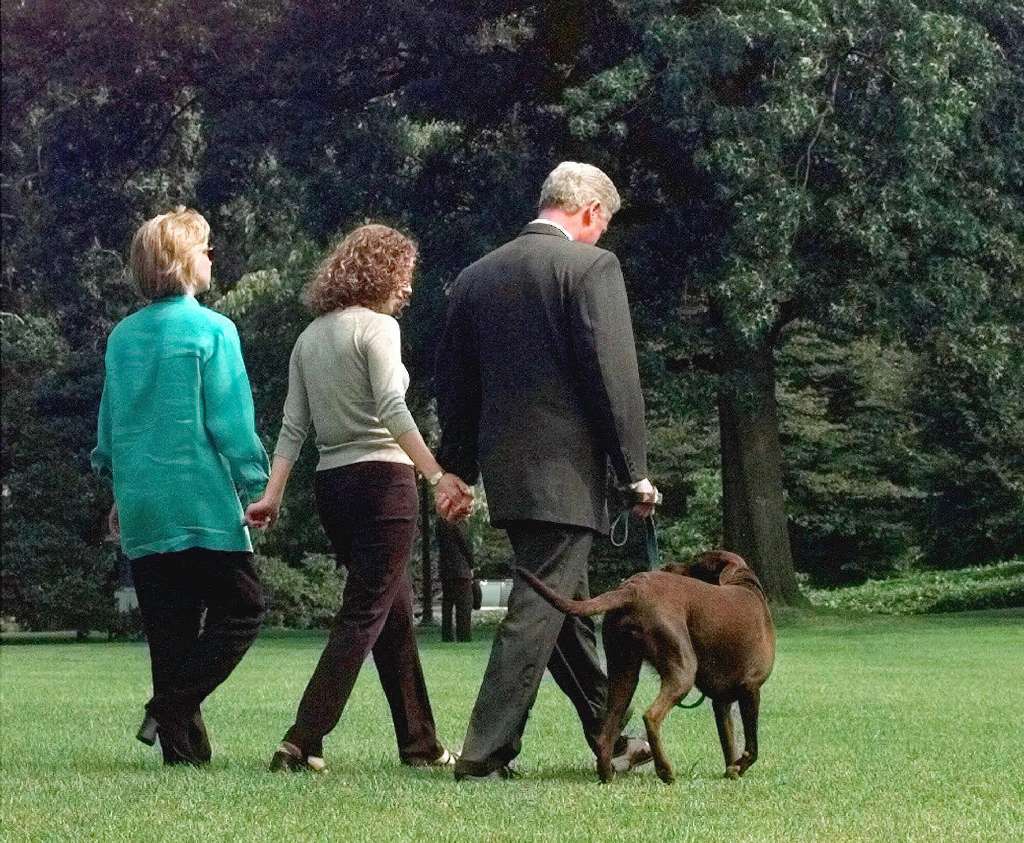 Primary Source: Photograph
This famous photograph was taken a few months after President Clinton admitted his affair with Monica Lewinsky. Hillary did not leave him or move out of the White House and their teenage daughter, Chelsea helped bring them together. The photograph was taken as the First Family walked across the White House lawn to a helicopter.
Some argued Clinton should have resigned, as Nixon did, but Clinton refused to quit and stayed in office. Many Americans thought the whole impeachment process had been driven more by politics than by a desire to apply the law fairly. In the end, Clinton remained popular, partly because the economy was doing well and also because of his foreign policy actions in the Balkans. He left office with a 66% approval rating, the highest for any outgoing president. Still, suspicion and controversy followed both Bill and Hillary Clinton afterward.
BUSH V. GORE
In 2000, Clinton’s vice president, Al Gore, ran for president. Gore tried to show he was not involved in Clinton’s scandals to try to win over voters who didn’t like Clinton, but doing this also upset some of Clinton’s supporters.
Republicans nominated George W. Bush, governor of Texas and son of former president George H. W. Bush. Bush had strong support from the Christian Right and Republican leaders.
About 100 million votes were cast. Gore won the popular vote by about 540,000 votes, around 0.5%. Election night was chaotic, with news reports calling the winner differently at different times. Eventually, it all came down to Florida. Whoever won that state, would have the most electoral votes and become the president.
Bush led Florida by a tiny margin. Because of voting problems and irregularities in some counties, especially in heavily Democratic and largely African American areas, Gore asked for a hand recount.
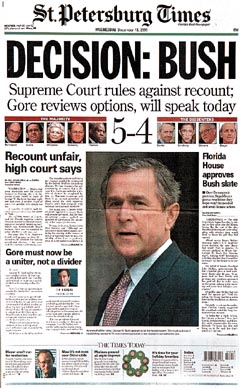 Primary Source: Newspaper
The 2000 election was not decided for over a month as recounts and court proceedings dragged on. Finally the Supreme Court decided the election by a 5-4 vote.
Both sides went to court over how to conduct the recount. The case reached the Supreme Court. In Bush v. Gore, the Court voted 5–4 to stop the recount. Bush won Florida’s electoral votes and became president with 271 electoral votes to Gore’s 266.
This was only the second time a president’s son became president. It was also the second time in U.S. history that the popular vote winner did not become president.
GEORGE W. BUSH
George W. Bush is best known for leading the country during the War on Terror and for the invasions of Afghanistan and Iraq. But he also had important domestic goals.
Before the September 11 attacks, Bush thought he would be remembered as the “Education President.” He believed schools should be held accountable through testing. Do do this, he signed the No Child Left Behind Act (NCLB). It required standardized tests in reading and math. Schools with low scores could be labeled “in need of improvement” and faced consequences.
Over time, many people felt the law created too much testing and did not solve deep problems. In 2015, Obama signed the Every Student Succeeds Act. Testing continued, but states gained more control over how to improve struggling schools.
In addition to testing, Bush also supported school choice. He backed charter schools, which are publicly funded but can accept private donations and have more freedom from some regulations. He also supported vouchers. With a voucher, parents could use tax money to help pay for private school. Teachers unions strongly opposed vouchers.
Like many Republicans since Reagan, Bush supported supply-side economics. In 2001, he pushed through a tax cut that lowered tax rates. The largest cuts went to the highest earners. Critics argued this increased inequality.
By 2005, the income gap between the richest and poorest Americasn was growing. For example, the CEO of Wal-Mart earned about $15 million. It would take more than 900 average Wal-Mart workers to earn that much. Even as productivity increased, many workers’ wages did not keep up. As wealth became more concentrated, the very rich gained more influence over the government.
After 9/11, Bush’s presidency changed. The War on Terror dominated politics. Bush won reelection in 2004, but his popularity started to fall.
In 2005, Hurricane Katrina devastated parts of the Gulf Coast. The city of New Orleans was badly flooded when levees failed. More than 1,500 people died. Tens of thousands were trapped, and many people sheltered in the Superdome without enough food, water, or sanitation.
The Coast Guard rescued many people, but other parts of the response struggled. The Federal Emergency Management Agency (FEMA) performed poorly. Critics blamed FEMA’s leadership and pointed out that Bush had appointed leaders who were his friends rather than people who had the skills to do a good job.
Photos of Bush looking down from Air Force One made some people feel he was disconnected from ordinary Americans. By 2006, his popularity had dropped, due to the Iraq War, Katrina, and the sense that his policies helped only the rich.
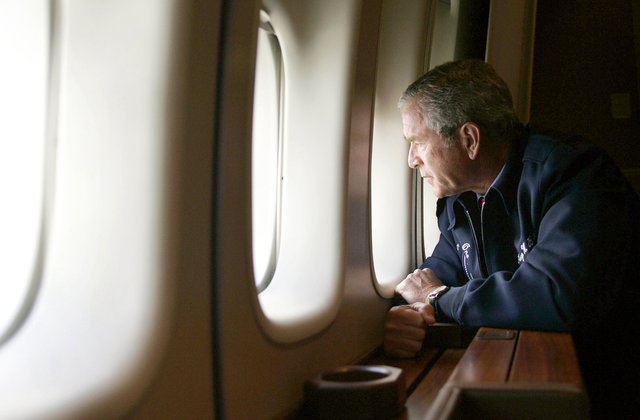 Primary Source: Photograph
In order to avoid interrupting the relief efforts on the ground, President George W. Bush chose to observe the devastation in New Orleans after Hurricane Katrina from Air Force One. Photos of him looking out of the plane’s windows backfired and gave people the impression that their president was disconnected from their problems and did not care about their suffering.
THE GREAT RECESSION
When people buy homes, they usually get a mortgage from a bank. Banks normally check whether buyers can repay. But in the 1990s and early 2000s, deregulation allowed banks to bundle many loans together and sell them to bigger banks and investors.
These bundles were called mortgage backed securities. Wall Street banks wanted them because they seemed profitable. After the good years of the 1990s, investors had extra money, in part because of tax cuts, and these securities looked safe.
But there was a major problem. Banks began making risky loans. The local banks did not worry if the home buyers could pay back the loans in the long term. What mattered most was selling a lot of mortgages that they could bundle together and then sell to larger banks. Because of this, local banks encouraged people to buy homes they could not truly afford. These risky loans were called subprime mortgages.
Big investment banks bundled risky loans into packages like collateralized debt obligations (CDOs) and sold them worldwide. Credit rating companies often labeled these investments very safe, even when they were not. A credit rating agency is supposed to warn investors about risk, but the rating agencies were paid by the same banks selling the products. This created a strong conflict of interest.
Financial institutions also created credit default swaps, a kind of insurance on investments. Banks paid one another for protection, thinking they would never need it. Over time, this linked the major banks together. When one struggled, many others were pulled into the crisis.
When the real estate market stalled after peaking in 2007, the system collapsed. Regular people could not pay their mortgages. When they tried to sell their houses, no one was willing to pay the same high prices that they bought them for in the first place. Many homeowners were “underwater,” meaning they had borrowed more for their mortgage than they could get by selling their homes. So, thousands of Americans stopped paying back their loans and the economy stalled.
More than 100 mortgage lenders went out of business. AIG, an insurance company, nearly collapsed. One of America’s largest banks, Lehman Brothers, failed in September 2008. Other firms, like Merrill Lynch, sold themselves to survive.
Congress met with Federal Reserve Chairman Ben Bernanke and Treasury Secretary Henry Paulson to stop the crisis. Congress passed the Emergency Economic Stabilization Act and created the Troubled Asset Relief Program (TARP). This law gave $700 billion to support struggling banks. The banks could use the money during the emergency to keep from going bankrupt but were expected to pay back the TARP loans when the economy recovered.
These actions helped prevent a total collapse and a repeat of the Great Depression. Still, the world economy fell sharply in the Great Recession.
Stocks lost about 45% of their value. Banks were afraid of giving out loans so businesses struggled to get money they needed and cut jobs. Many people stopped buying homes. Home values fell, and people could not borrow against their homes to pay other debts. Millions faced payments they could not afford.
During late 2008, about one million workers lost jobs. In 2009, another three million became unemployed. Many people were furious that banks were rescued with taxpayer money, while ordinary Americans suffered.
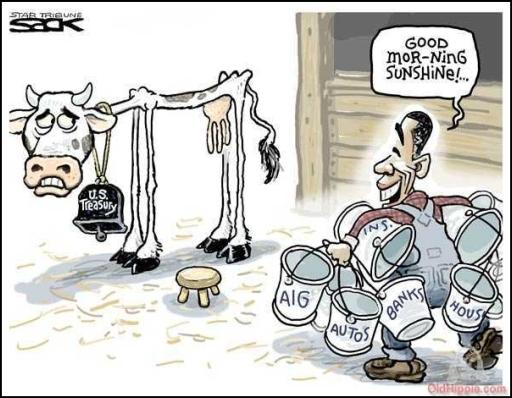 Primary Source: Editorial Cartoon
This artist is poking fun at the bailout programs implemented to save the financial system after the financial crash in 2007. President Obama is seen coming to take more tax money to give away to financial institutions that had cause the Great Recession.
Barack Obama, born in Hawaii in 1961, was elected president in 2008 just when the Great Recession was started. He ran on a promise of “hope and change.” Many voters wanted new leadership after the Iraq War, Hurricane Katrina, and the economic crisis.
Obama took over the TARP program and oversaw huge efforts to stabilize the economy. In addition to homes, banks were not giving loans to people to buy cars, and Americans who were losing their jobs had no money to buy cars. The major car makers in America were in danger of going bankrupt. Obama and Congress approved $80 billion for Chrysler and General Motors. Critics called it a government takeover, but the money helped prevent more job losses. By 2013, the automakers had repaid over $50 billion.
Obama also signed the American Recovery and Reinvestment Act, known as The Stimulus. It put almost $800 billion into the economy to create jobs and encourage growth.
GROWING POLITICAL DIVISION
Obama’s biggest domestic goal was healthcare reform. Democrats tried to learn from Clinton’s earlier failure. In 2009, they worked with insurance companies and doctors to write the Patient Protection and Affordable Care Act, nicknamed Obamacare.
This was the biggest change to healthcare since Medicaid in 1965. The goal was to make health insurance more affordable and available.
A key idea was that everyone would pay into the system. Before Obamacare, many healthy young people did not buy health insurance since they assumed they would not likely need to go to the doctor or hospital. The Affordable Care Act required all Americans to buy insurance. This way, the people who did not need care would help pay for the people who did.
The law also ended the ability of insurers to deny coverage for people with preexisting conditions.
Republicans did not support the bill. After it passed, Republicans pushed for repeal and many states sued. Anger over Obamacare helped Republicans win the House in 2010. Later, Republicans removed the requirement to buy insurance, but kept protections for preexisting conditions.
The Great Recession, the bailouts, the stimulus, and Obamacare created a strong backlash in public opinion.
Some people believed the economy was rigged to help the wealthy. They saw bailouts and executive pay as proof. Protesters formed the Occupy Wall Street movement. They used the slogan “We are the 99%” and the #Occupy hashtag.
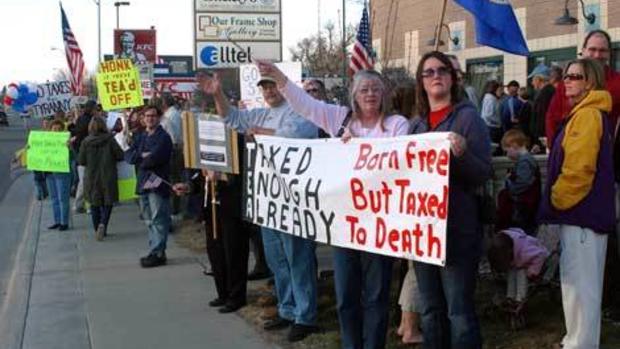 Primary Source: Photograph
A Tea Party protest rally. Events such as this were organized by voters who wanted to show their discontent with Obamacare and the economic recovery programs such as TARP and the Stimulus.
Other Americans focused their anger on taxes and government spending. They formed the Tea Party. Supporters carried signs like “Taxed Enough Already.” They were especially angry that Obamacare expanded Medicaid using tax dollars. The Tea Party helped elect many anti-tax Republicans in 2010.
When the White House and Congress are controlled by different parties, it can be hard to pass laws. In the 2000s, compromise became even harder.
In Obama’s second term, the economy remained slow. Wars in Iraq and Afghanistan continued. Terrorism struck again in 2013 with the Boston Marathon bombing.
Obama struggled to pass immigration and environmental plans through Congress, so he used executive orders. That meant he told agencies how to enforce laws or adjust rules.
The most obvious example had to do with people called the Dreamers. Normally, people who enter the U.S. illegally can be deported. But some young people were brought as children by their parents. These young people have become known as the Dreamers.
Obama supported the DREAM Act which would have protected the Dreamers from deportation, but it did not pass Congress. So instead, he created the Deferred Action for Childhood Arrivals (DACA).
Obama argued that law enforcement should focus on serious criminals. He said he had prosecutorial discretion to set priorities when resources were limited. He argued that since Congress would not spend enough money to hire the federal agents needed to deport all illegal immigrants, Obama would order the agents he had to focus only on criminals and ignore the Dreamers. Conservatives said he was simply trying to change the law on his own by ignoring the laws he didn’t like.
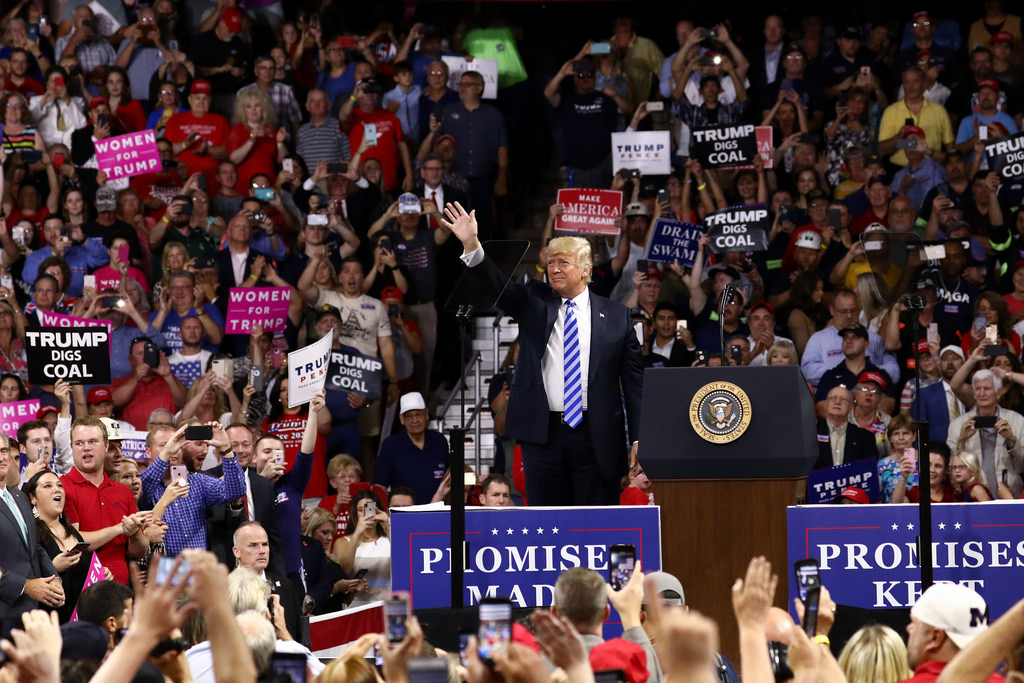 Primary Source: Photograph
President Trump is seen here in a campaign rally during his presidency. Some of the signs mention coal, which is an industry the president promised to protest.
DONALD TRUMP
Donald Trump, a New York real estate investor and TV celebrity, won the presidency in 2016 by cleverly connecting many trends that had been building during the previous years.
Some voters feared demographic change and disliked Obama’s DACA program and policies. They supported Trump’s promise to build a wall on the Mexican border. Many workers in the Rust Belt liked his promise to bring back factory jobs. Some voters supported his promise to renegotiate NAFTA and reduce environmental regulations. Tea Party supporters liked his focus on cutting taxes and attacking Obamacare.
Many conspiracy theorists supported Trump because he pushed birtherism, the false claim that Obama was born in Kenya. Some voters who tired of the wars in Iraq and Afghanistan liked Trump’s “America first” message and his proposal to ban Muslim immigrants.
Trump ran against Hillary Clinton and called her “Crooked Hillary,” reminding voters of past Clinton scandals.
Trump won by narrowly winning key states, especially in the Midwest. Hillary Clinton won the popular vote with big wins in states like California and New York, but Trump won the Electoral College. This was the fifth time in U.S. history that the popular vote winner did not become president.
Trump’s first four years as president were turbulent. He delivered tax cuts and restricted immigration from some majority-Muslim countries. He avoided some foreign conflicts and pulled out of major agreements. He renegotiated NAFTA and reduced environmental regulations. He appointed three conservative Supreme Court justices.
At the same time, his administration struggled to fill many jobs with experienced staff. Some of his policies were challenged in court.
One major promise was a border wall. Trump demanded funding, and when Congress refused, the government shut down. It became the longest shutdown in U.S. history up until that point. Eventually, Trump reopened the government without new wall funding and use some military funds to wall construction claiming that it was necessary to defend the county. In total, about 49 miles of new wall were built.
Trump also reduced immigration through family separation. Families were separated at the border when caught crossing illegally. Many Americans saw this as inhumane, especially when children were held in crowded facilities. In 2018, a federal judge found the government had “no system in place to keep track of” separated children and ordered families reunited. Officially, the practice stopped, but separations still continued for some time.
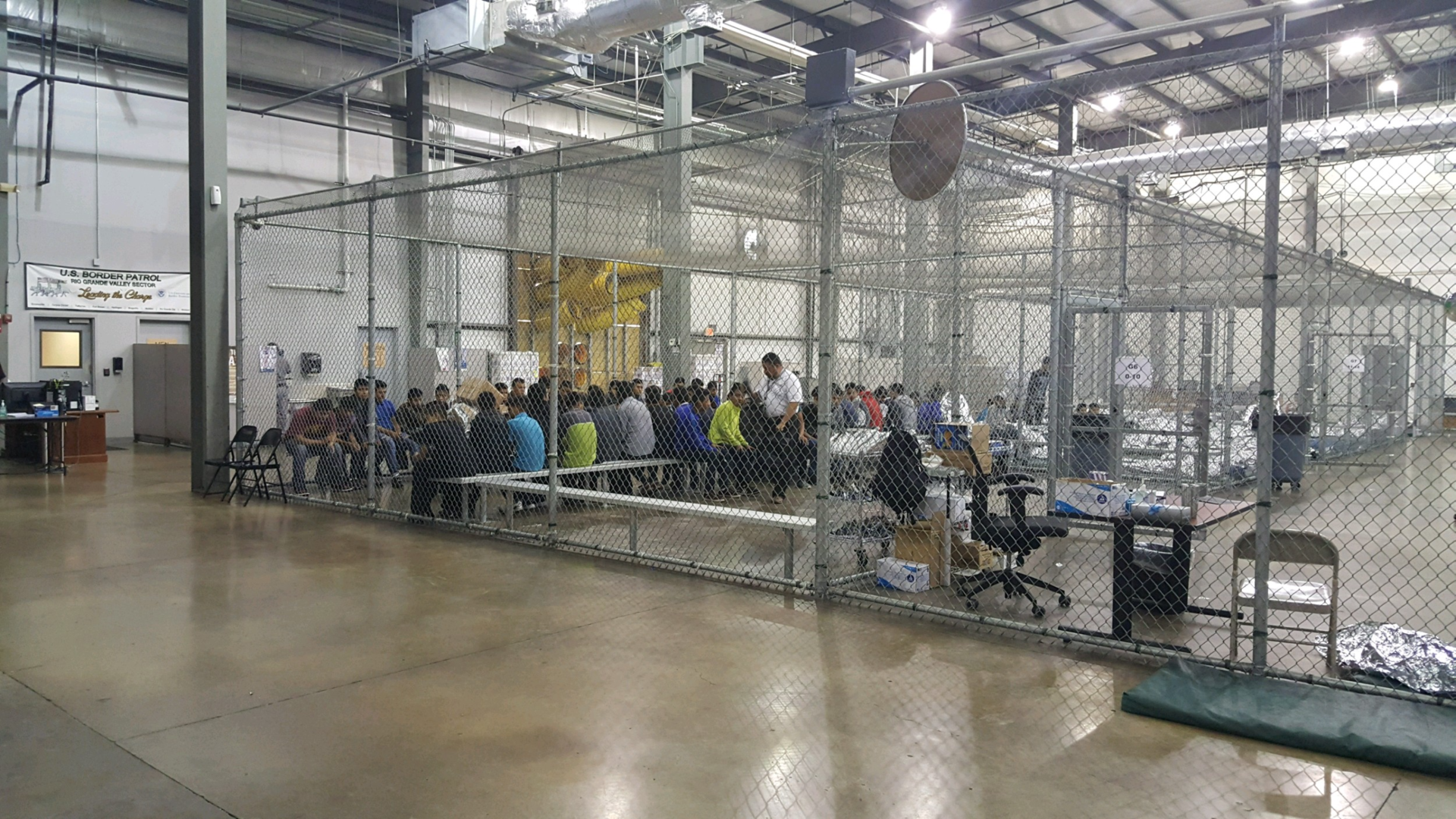 Primary Source: Photograph
A detention center for minors along the border with Mexico. Facilities like this one led many Americans to accuse the Trump Administration of inhumanely holding children in “cages.”
Partly in response to Trump’s comments about women, more women became active in politics and public life. The 2018 elections included a record number of women candidates. Another major change involved speaking out about sexual abuse.
In 2017, after reports about movie producer Harvey Weinstein, the hashtag #MeToo spread widely. It encouraged people to share experiences and hold abusers accountable. Public figures including Alyssa Milano, Gwyneth Paltrow, Ashley Judd, Jennifer Lawrence, and Uma Thurman shared stories. Others exposed included Bill Cosby, Al Franken, Larry Nassar, and R. Kelly.
Trump promised to “drain the swamp,” but many people felt government did not change much. His frequent use of social media, his exaggerations, and his rejection of traditional presidential norms made his presidency feel different.
He was criticized because he did not separate his personal business and his work in government the way most Americans expected him to. He also brought family members into government roles, leading to accusations of nepotism.
Trump lost reelection to Joe Biden in 2020. One major reason was his handling of the coronavirus pandemic. COVID-19 began in late 2019 and spread worldwide. It was more deadly than the flu and spread easily through the air.
Scientists recommended social distancing, hand washing, and mask wearing. But in the U.S., responses often depended on politics. Many conservatives opposed these mandates, claiming that there were examples of the government having too much power and as limits on personal freedom. Trump downplayed the risk of COVID early on, refused to wear a mask, and was hospitalized after catching the virus. As cases rose, many voters blamed him for weak leadership.
Trump was also accused of abusing power. He became the first president to be impeached twice.
In 2019, Democrats accused him of refusing to send money Congress had decided to sent to help the country of Ukraine defend itself from Russia. They said that Trump was holding onto the money to try to get Ukraine to start an investigation of Joe Biden’s son that might help Trump win the upcoming election. Democrats in the House voted to impeach the president, but the Senate acquitted him.
In 2021, after losing the election, Trump claimed the election was stolen and refused to concede defeat. On January 6, 2021, as Congress met to certify the election, Trump held a rally and urged supporters to march to the Capitol. Some of them violently attacked and entered the Capitol Building.
Congress stopped its work and members went into secure areas. Both police officers and attackers died in the chaos. Later that night, Congress returned and certified Biden’s victory. Democrats then charged Trump with inciting a revolt against the government.
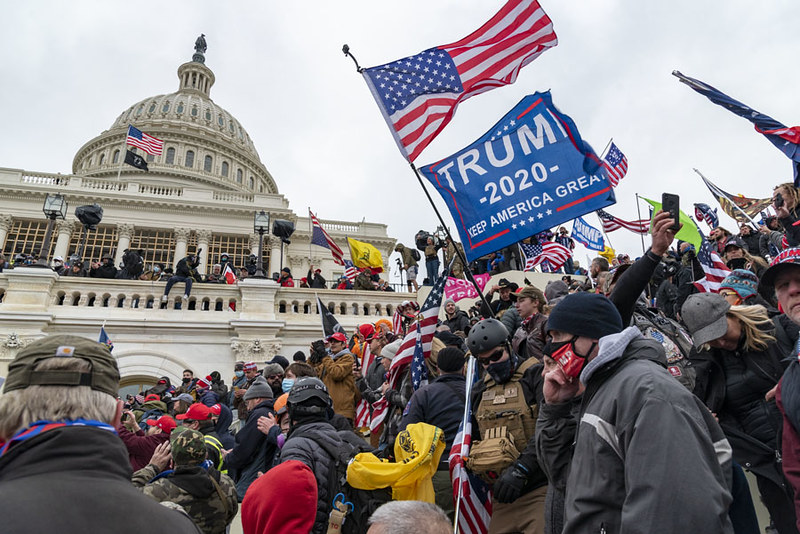 Primary Source: Photograph
Trump supporters breaking into the Capitol Building on January 6, 2021 in a failed attempt to stop Congress from certifying the results of the 2020 presidential election. The attack led to multiple deaths, hundreds of arrests, and the second impeachment of President Trump.
Because Biden had already taken office, the Senate could not remove Trump. But it could still convict him and ban him from running again. More Republicans voted against Trump the second time, but not enough for a 2/3 conviction. The impeachment failed.
Even after leaving office, Trump remained popular among Republicans and in 2024 he won reelection for a second term as president.\
CONCLUSION
By many measures, our political system is not working well. The two parties rarely agree. Social media and cable news intensify anger. Many voters have become more tribal. People support flawed leaders they think on on their side rather than consider candidates from the other party. Anyone who has read William Golding’s Lord of the Flies might see uncomfortable parallels.
But it is also important to notice what has still held steady. Elections have happened on time, even during wars and pandemics. Twice in the past 20 years, the majority of voters did not get the outcome they wanted, but power still transferred peacefully. Even when a losing president claimed victory, courts and election officials protected the integrity of the vote.
Maybe the framers had more foresight than we give them credit for. Long before social media, they wrote a Constitution that has survived civil war, global conflict, civil rights struggles, scandal, depression, recession, and lies.
What do you think? Is our political system broken?
CONTINUE READING
- Previous: The Digital Revolution
- Next: Conclusion
SUMMARY
BIG IDEA: Politics in America has always been contentious and there have never been some “good old days” when everyone got along and debated respectfully. However, in the past 30 years the Great Recession, taxes, government spending, racial justice issues, immigration, mass media, the rise of social media, and the personal failings of politicians have all contributed to a shift toward more extreme division.
George H. W. Bush was the last president from his generation. He lost his bid for reelection in 1992 to Bill Clinton. Clinton was the first Baby Boomer president and was famous for his engaging personality and also for scandal. Clinton described himself as a New Democrat and embraced some conservative ideas. This helped him win in a time when conservative ideas were more popular.
Clinton signed NAFTA but failed to reform healthcare. In 1994 Republicans took back control of Congress for the first time in decades and a period of confrontation between Congress and the President ensued. Clinton’s scandals hurt him in his second term. Investigations of his business deals morphed into an investigation of an affair he had while he was president. He was impeached by the House but not convicted in the Senate. In the end, however, his political talents and a robust economy saved him, and he was the most popular outgoing president ever.
The 2000 presidential election was very close. It all came down to Florida where Al Gore asked for a recount. The procedures ended up being debated in the courts and in the case of Bush v. Gore the Supreme Court handed the election to George W. Bush. It was a rare case when the winner of the popular vote did not become president.
Bush implemented tax cuts for all Americans, especially the wealthy in keeping with traditional Republican ideas about how to support the economy. During his presidency there was a growing divide between the very rich and most other Americans. He also signed the NCLB education law. Later he concentrated on the War on Terror. The War in Iraq and the government’s botched response to Hurricane Katrina ruined his popularity during his second term.
Deregulation and speculation led to problems in the financial markets. A real estate bubble grew during Bush’s tenure that included the creation of mortgage-backed securities and credit default swaps. In 2007 everything came crashing down and the Great Recession started. Bush and Obama responded by bailing out banks and the auto industry. Later, Obama passed a stimulus bill to pump tax money into the economy.
President Obama and Democrats passed healthcare reform in 2009. The government’s response to the Great Recession and Obamacare were unpopular with voters on both the right and the left. Occupy Wall Street and the Tea Party grew as a result. Republicans in Congress formed fierce opposition to Obama. He responded by using executive orders to make significant changes to environmental and immigration policy.
Beginning in the 1990s the United States has grown increasingly politically polarized. Republicans and Democrats work together less, are more divided geographically, are less likely to vote for someone from the other party or even to have friends from the other party. Extreme partisanship is fueled by media outlets and amplified by social media where algorithms are designed to help you find like-minded people, thus isolating people from dissenting opinions. More and more voters are likely to describe the other party as hating America and trying to ruin the country.
Donald Trump won in 2016 by capitalizing on various political trends, such as anti-globalization, anti-environmentalism, fatigue of wars, Clinton scandals, and anti-feminism. President Trump broke with tradition in many ways, which was part of why his supporters liked him. Although most presidents stretch the truth, Trump told an unprecedented number of lies during his four years in office. His willingness to lie and attacks on his political opponents led to him being impeached twice, once for asking the President of Ukraine to help him find information that would hurt then-candidate Biden and a second time for encouraging his supporters to attack the Capitol Building.
Over the past few decades an intense political debate has emerged around questions related to immigration. As a result of immigration reform in the 1960s, large numbers of immigrants have arrived from Asia and Latin America. Some believe it is time to start to reduce the number of arrivals. Others view these new residents as a benefit to America. Since most non-White Americans vote Democratic, the debate over immigration has become intensely politicized. Fights over the fate of children brought to the country illegally and criticism of President Trump’s proposed border wall and ban on Muslim immigrants made immigration a major political issue in the 2010s.
In response to Trump’s accusations of sexual abuse, the #MeToo movement rose to expose abusers and assert women’s power in American politics.
VOCABULARY

PEOPLE AND GROUPS
Bill Clinton: Former governor of Arkansas who won the presidency in 1992 as a Democrat and served eight years. His second term was rocked by scandal and impeachment.
New Democrats: Democrats in the early 1990s who found ways to be elected after the Conservative Revolution by promoting free trade and welfare reform. Bill Clinton used this term to describe himself.
Hillary Clinton: First lady to Bill Clinton. She led a task force during his presidency to prepare for healthcare reform. Later she served as senator from New York, Secretary of State, and ran for president.
Newt Gingrich: Republican Speaker of the House of Representatives who proposed the Contract with America in 1994, lead the Republican Revolution, and was Bill Clinton’s leading political opponent.
Kenneth Starr: Independent prosecutor appointed to investigate Bill Clinton’s wrongdoing. He investigated both the Whitewater real estate deal and Clinton’s affair with Monika Lewinsky.
Monica Lewinsky: White House intern who had an affair with President Bill Clinton.
George W. Bush: Republican president elected in 2000 and reelected in 2004. He is remembered mostly for prosecuting the War on Terror, but also instituted education reforms and oversaw the beginning of the Great Recession.
Ted Cruz: Republican senator from Texas who has strong backing from the Tea Party movement and promoted a government shutdown during Obama’s presidency. He ran unsuccessfully for president in the Republican primary election in 2016.
Dreamers: Nickname for illegal immigrants who were brought to the United States as children.
Donald Trump: New York real estate investor and television celebrity won the presidency in 2016 as a Republican.

KEY IDEAS
Perjury: Lying under oath. It is a crime.
Impeachment: The Constitutional process of removing an elected official or judge. In the case of a president, the House of Representatives serves as the prosecutors and the Senate as the jury.
Charter Schools: Independently run schools that operate with public funding. They are seen by many as opportunities for educators to innovate and provide options for families who live in neighborhoods with failing schools.
School Vouchers: A system in which parents can receive public tax dollars to pay for private school tuition. Proponents believe it gives parents choice and students a chance at a better education. Opponents believe it robs public schools of needed funding.
Preexisting Conditions: Medical problems that a patient has before applying for health insurance. Before the passage of Obamacare, insurers could deny coverage because they knew patients would need medical care.
The 99%: Nickname coined by the Occupy Wall Street movement in 2011 to describe everyday Americans in contrast to the superrich who they believed controlled business and political decisions.
Prosecutorial Discretion: The idea that the president as chief law enforcement officer can choose which type of crimes to focus resource on. President Obama used this concept to announce that illegal immigrants who had not broken laws would not be subject to deportation.

QUOTES
“Read my lips: no new taxes”: Campaign promise by George H. W. Bush in 1988 that cost him support when he had to break it later as president.
“I did not have sexual relations with that woman”: Famous quote by President Bill Clinton when he denied his affair with Monica Lewinsky on television.

GOVERNMENT AGENCIES
Federal Emergency Management Agency (FEMA): Government agency under the Department of Homeland Security that is responsible for coordinating rescue and relief operations after disasters or terrorist attacks. Their response to Hurricane Katrina was widely criticized.

ECONOMIC CONCEPTS
Mortgage Backed Securities: Investments that were made up of a collection of home loans bundled together and sold as a single unit.
Subprime Mortgage: A home loan made to a lender that was unlikely to be able to repay it. They were sold in large numbers in the early 2000s in order to make mortgage backed securities and when they failed it caused the Great Recession.
Credit Rating Agency: A company that gives a score to investment opportunities to rank them in terms of their risk. They are important in order to help investors manage risk.
Credit Default Swap: Insurance investment banks took out on their investments with other large banks. Because all the large banks had these with all the other large banks in the early 2000s, the Great Recession had a domino effect within the financial markets.

COURT CASES
Bush v. Gore: 2000 Supreme Court case in which the Court ruled to end a recount of votes in Florida, thus handing the presidential election victory to George W. Bush. It marked an important turning point in the politicization of the Supreme Court.

EVENTS
Republican Revolution: Nickname for the electoral gains made by congressional Republicans in 1994. For the first time in decades Republicans took control of the House of Representatives.
Hurricane Katrina: Major natural disaster in 2005. The federal government’s response was widely criticized which hurt President George W. Bush’s popularity.
Real Estate Market Crash: 2007 economic disaster in which investors and home buyers finally realized that housing prices were inflated and stopped buying. People were left with mortgages they couldn’t pay and homes they couldn’t sell.
Great Recession: Economic crash starting in 2007 caused by speculation in the housing market and lax oversight of the financial markets. It was the worst financial crisis since the Great Depression and caused unemployment to peak at 10%.
Occupy Wall Street: Protest movement in 2011 focused on real and perceived inequality in the economy, especially on the influence of the wealthy in government and the growing wealth divide between the superrich and everyday Americans. They coined the phrase “We are the 99%.”
Tea Party: Political protest movement within the Republican Party in 2009 that formed in reaction to passage of Obamacare. They focused on lowering taxes and reducing government spending. Members of Congress with backing of these voters usually used extreme tactics including shutting down the government to try to achieve their goals.
MeToo: Movement to expose perpetrators of sexual abuse. It was started in 2017 by women in the entertainment industry who using social media to tell their stories.
Coronavirus Pandemic: Global outbreak during 2020 and 2021 that killed more than 500,000 people in the United States.
First Impeachment of Donald Trump: First attempt by Democrats to remove President Trump from office. It was a response to his effort to get Ukraine to investigate Joe Biden’s son.
The Big Lie: Donald Trump’s refusal to concede defeat in the 2020 election and effort to convince Americans, without evidence, that the election was somehow stolen from him.
2021 Storming of the Capitol: Attack by supporters of President Trump on the Capitol Building in an effort to prevent Congress from certifying the results of his electoral loss to Joe Biden. It led to Trump’s second impeachment.
Second Impeachment of Donald Trump: Attempt by Democrats to hold President Trump accountable for his role in the 2021 Storming of the Capitol.

LAWS, POLICIES & PROGRAMS
Contract with America: Set of eight proposals set out by Republicans in 1994 which helped propel them to retake the House of Representatives.
Welfare Reform: Efforts in the 1990s to change welfare laws by including a requirement that people receiving welfare begin working within two years.
Bush Tax Cuts: Reductions in taxes for all Americans, but especially for the wealthy, implemented by George W. Bush in 2001.
No Child Left Behind Act (NCLB): Education reform law passed by George W. Bush in 2002 which introduced a system of high-stakes testing and the possibility of restructuring for low performing schools.
Troubled Asset Relief Program (TARP): Government program designed to save banks during the Great Recession. The government loaned banks enormous sums of money in order to help them survive as they dealt with all of the failed investments they had purchased during the housing boom.
The Stimulus: Economic program signed by Barack Obama to help boost the economy during the Great Recession. It included investing $800 billion in infrastructure and green technologies.
Obamacare: Nickname for the Affordable Care Act passed in 2009 by Democrats in Congress and Barack Obama. In included guarantees of coverage for patients with preexisting conditions, and expansion of Medicaid and a mandate that everyone purchase healthcare coverage.
Deferred Action for Childhood Arrivals (DACA): Government program that provides amnesty for illegal immigrants who were brought to the United States as children.
DREAM Act: Proposed law to allow illegal immigrants who were brought to the United States as children a chance to become legal residents and eventually become citizens. It has not passed Congress due to opposition from Republicans.
Border Wall: A barrier along the southern border with Mexico. Expanding the wall was one of President Trump’s key campaign promises and an ongoing political issue during his presidency.
Family Separation: The policy of separating parents and children of illegal immigrants in an effort to discourage immigration.